
Monroe County Court Records After Arrest
Monroe County court records after a jail arrest are handled through the Kentucky Court of Justice. The local court record path runs through Monroe County Justice Center and the Office of Circuit Court Clerk. Research identifies Circuit Court Clerk Kim Hagan, the justice center at 300 N. Main St. in Tompkinsville, phone 270-487-5480, fax 270-487-0068, and regular office hours Monday through Friday from 8 a.m. to 4 p.m. The official court page says the clerk's office is the starting point for requesting copies of case records from cases in that county.
The jail side and the court side should stay separate. The jail roster answers whether a person is in custody and may list booking or arrest charges. For custody details, use Monroe County jail inmate records. For booking photos, use the Monroe County jail mugshots page. Court records after arrest answer what the prosecutor filed, what division heard the case, whether a warrant or bond order exists, and how each charge changed over time.
Find Court Records After Arrest
The free docket route is the Kentucky Court of Justice docket portal. It can search court dates by county, division, date, courtroom, and subdivision. Select Monroe as the county, then choose the correct division if known. District Court often handles misdemeanors, violations, traffic, preliminary felony hearings, juvenile matters, small claims, probate, and domestic violence matters. Circuit Court handles felony prosecutions and higher-level matters.
- Open the Kentucky Court of Justice docket portal.
- Select Monroe County and the correct court division when known.
- Enter the required docket date and review courtroom or subdivision options.
- Use the clerk's office for official copies, older files, and case-record questions.
Account-based online case access may also be available through Kentucky eCourts or CourtNet. The docket portal disclaimer says the information cannot be used for employment, licensing, or eligibility for government programs, is not an official docket, and is subject to change. For formal record use, verify with the clerk.
The official Monroe County Court of Justice page is the source shown below.
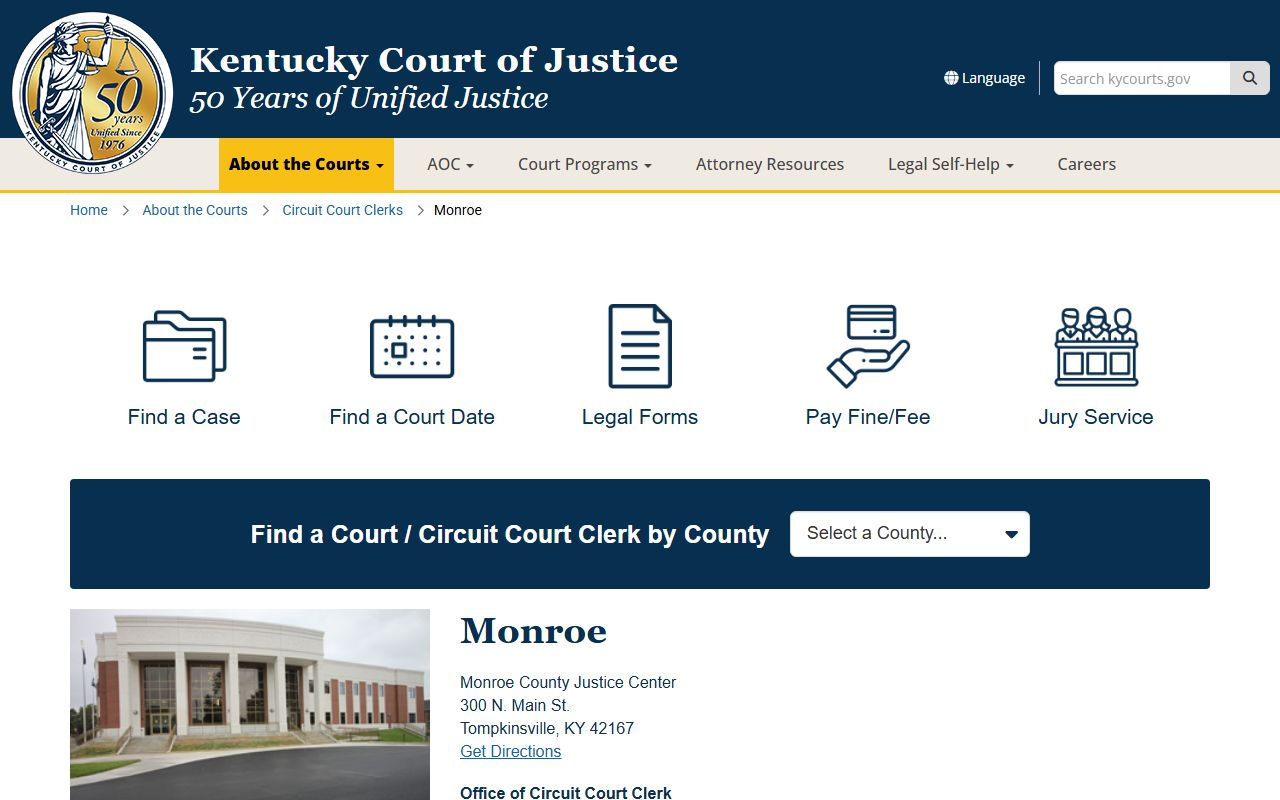
The court page is the local source for clerk contact, hours, accessibility, payment options, and court-record guidance.
Monroe County Court Search Fields
The docket portal uses structured fields rather than a broad jail-style name search. That matters after a jail arrest because the first public court event may be tied to a date and division, while the booking record may still be held by the jail. If the date is unknown, call the clerk or check any citation, bond paper, or release paperwork issued after booking.
| Field label | Type | Required | Options or notes |
|---|---|---|---|
| County | Dropdown | Yes | Select Monroe from Kentucky counties. |
| Division | Radio or dropdown | Yes | Choose Circuit or District. |
| Date | Date | Yes | Required docket date. |
| Courtroom | Dropdown | No | Default can be all courtrooms. |
| Subdivision | Dropdown | No | Default can be all subdivisions. |
| Submit | Button | Yes | Generates the docket. |
The Kentucky docket portal screenshot below shows the search controls used for court-date lookup.
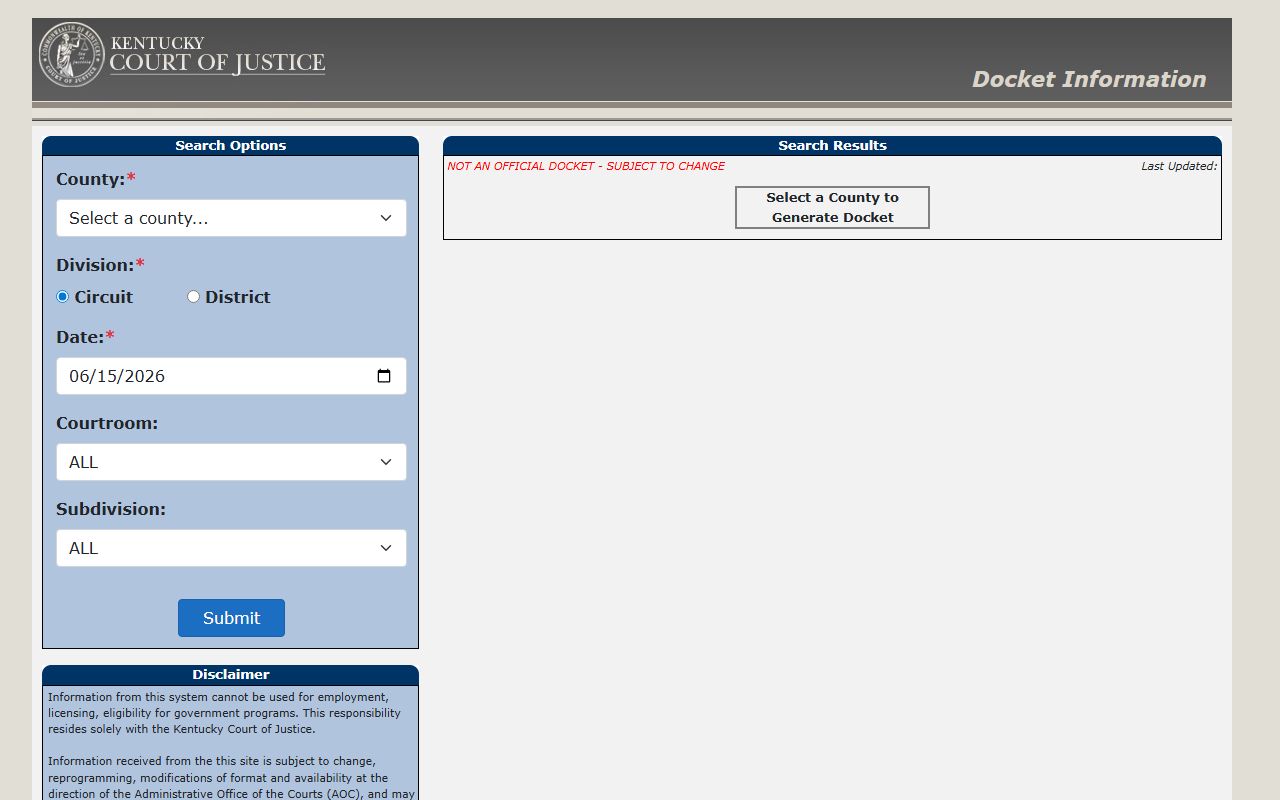
Docket search is useful for hearing dates, but official court records and copies still come from the clerk's office.
Charges Filed After Arrest
A Monroe County arrest can start with a citation, complaint, police report, or warrant, but the court record becomes clearer when a charging document is filed. A complaint can start many district-level criminal cases. An information is a prosecutor-filed charge document. An indictment is returned by a grand jury and is common in serious felony matters. Kentucky terminology can vary by case stage, so treat the table as a plain-English map, not a substitute for reading the actual file.
| Document | Usually filed by | Role in the court record |
|---|---|---|
| Complaint | Officer or prosecutor | States allegations and can begin a criminal case. |
| Information | Prosecutor | Lists formal charges without a grand-jury indictment in eligible cases. |
| Indictment | Grand jury | Moves felony allegations forward in Circuit Court after grand-jury action. |
Monroe County Charge Status
Booking charges and court charges can diverge. A jail roster may show the arrest charge entered at intake. A court file may later show an amended charge, a reduced charge, a dismissed charge, or a conviction after plea or trial. A disposition is the outcome of a charge. A remand means the court orders the person back into custody. A detainer is a hold from another agency and can block release even if a local bond is paid.
| Status | What it means |
|---|---|
| Pending | The charge is active and has not reached final disposition. |
| Amended or reduced | The filed charge changed, often by prosecutor action or plea agreement. |
| Dismissed | The charge was dropped by court order or prosecutor action. |
| Convicted | The charge resulted in a guilty plea, verdict, or other conviction disposition. |
| Bench warrant | A court order for arrest, often tied to failure to appear or violation of an order. |
Bond After Monroe County Arrest
Bond can change after the first court appearance. Kentucky release terms may include cash bond, surety bond through a bail agent, unsecured or partially secured conditions, release on recognizance, or a no-bond hold. A PR bond means release on personal recognizance. A no-bond hold means release is not available on that charge or hold at that point. The jail can confirm whether it will accept payment for a specific inmate and what payment method or timing applies.
| Bond type | How it works |
|---|---|
| Cash bond | Money is paid under the court's terms before release. |
| Surety bond | A bail agent posts bond under the court's conditions. |
| Recognizance release | The person is released on a promise to appear and comply. |
| No-bond hold | Release is blocked by court order or another legal hold. |
Check both the jail and the court. A detainer from another county, state probation or parole, federal authorities, or ICE can affect release even after a local bond is paid.
Warrants and Court Records
No official Monroe County active-warrant search was located in the research. Use agency-based verification. Call Monroe County Sheriff at 270-487-6622 for sheriff warrant questions. Contact Monroe Circuit Court Clerk at 270-487-5480 for bench warrants tied to court cases. The docket portal can show upcoming dates, but it should not be treated as a warrant-clearing system. Contact an attorney or the court before walking in on a possible warrant.
Arrest warrants authorize custody on a charge. Bench warrants are often issued after failure to appear or violation of a court order. Search warrants authorize a search, not an arrest by themselves. Fugitive or hold warrants may involve another county or state. If a warrant leads to arrest, the person may be booked through Barren County Detention Center and then appear in Monroe County court.
Charges vs Convictions
Being arrested and charged is not the same as being convicted. A charge is an allegation. A conviction is a court outcome. Court records after a Monroe County jail arrest may show each stage, so read the status line and disposition instead of relying only on the charge name.
| Charge | Conviction | |
|---|---|---|
| Stage | Accusation or filed allegation | Final outcome by plea, verdict, or judgment |
| Proof level | Probable cause or charging standard | Beyond a reasonable doubt or guilty plea |
| Record meaning | Shows what was alleged | Shows what was legally resolved as guilt |
Sealed Expunged Arrest Records
Kentucky expungement rules can affect public court records after a Monroe County arrest. KRS 431.073 provides a path for eligible felony conviction vacation and expungement. The Kentucky Court of Justice also publishes an expungement certification process. If an arrest is dismissed or later expunged, the person should follow the court process and then contact each record custodian that still shows a record.
| Sealed | Expunged | |
|---|---|---|
| Public view | Hidden from ordinary public access | Treated as cleared under the court order |
| How it happens | By statute or court order | By eligibility, certification, filing, and court order |
| Record holders | May still exist with limited access | Custodians must follow the expungement order that applies to them |
Restricted Monroe County Court Records
Not all court or arrest records are released in the same way. Kentucky open-records law supports access to nonexempt public records, but juvenile confidentiality, sealed cases, expungement, ongoing-investigation limits, identity protections, and agency-specific rules can restrict release. The docket portal also states that its information is not an official docket and is subject to change.
Important: Do not use casual court, jail, or search-tool results for employment, housing, credit, insurance, or other FCRA-covered decisions.